Saturday, March 26, 2011

Empty Box 2011 - Box13 exchanges white space for gr$$n.

On Saturday, 3/12/2011, Box13 had its annual fundraiser, Empty Box.


As in past years, the event centered around the raffling off of art work donated by local artists. For $50 a ticket, participants were able to enter mini-raffles for the individual art work of their choice. For $5, they could enter the poor man's raffle, which was a standard raffle.
Upstairs, the resident artists of Box13 conducted a silent auction. Houston film maker and media maven, Stephanie Saint Sanchez DJ'd the event.

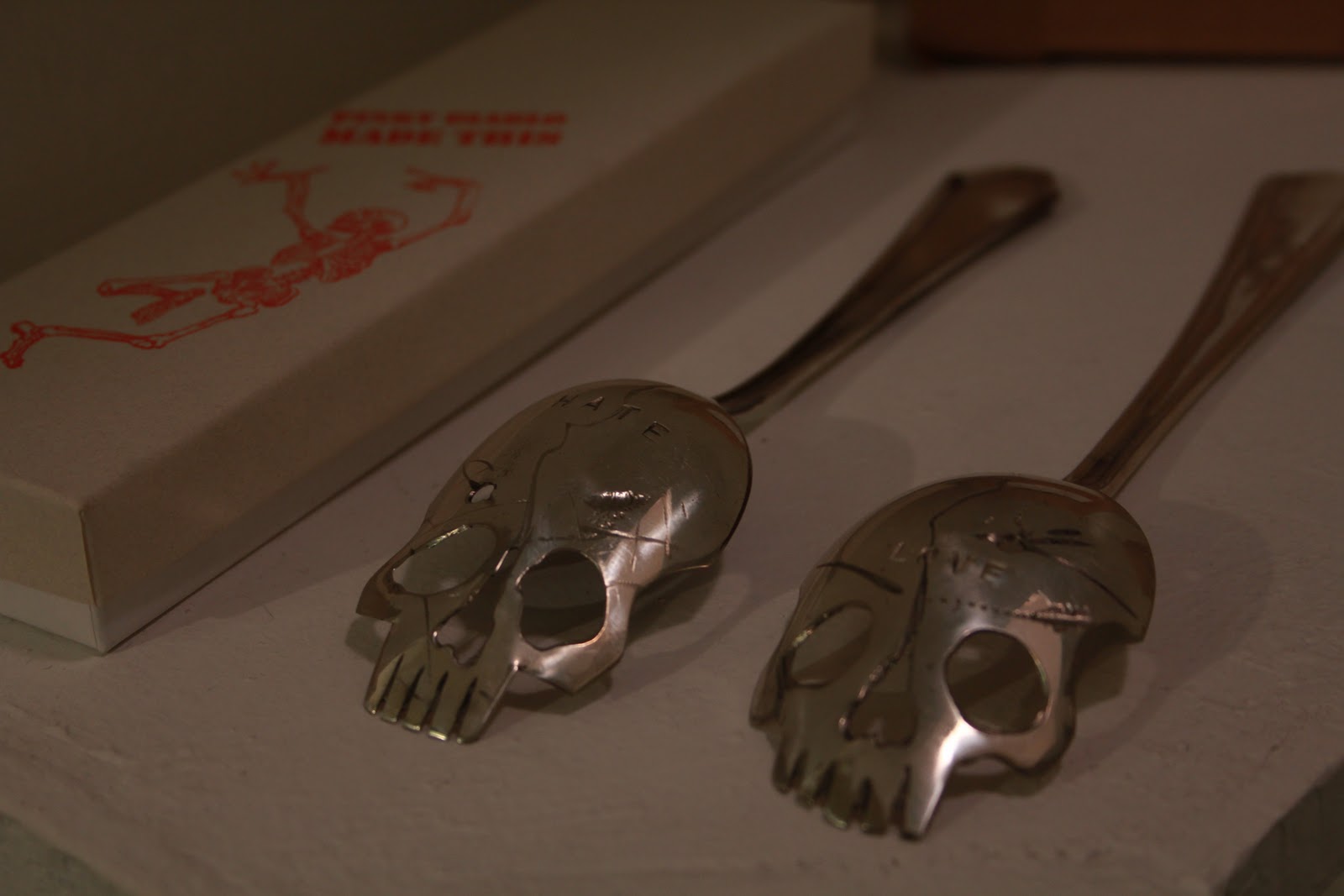
Here are some of the works that caught my eye with my camera in focus. However, I did not capture the artist or title...but will gladly add them if someone provides them.

Parent issues? What parent issues?
Both the model and his medallion were unable to attend.
David Lynch fantasizes of Betty Boop?
Dddaaammmnnnn!!!
Stealth cone
Tessellations done oh so right


Myth mashup

Participants gnoshed on guacamole, mingled, and cast their lots. Eugenious(sp?) of Gorealah Soul crashed the party with his bear-costumed cohort and serenaded us.

Fuck greeting cards. Say it with a bullhorn.

With a bear as your wing man, you will never lack a cuddle.
 Volunteers kept the crowd nourished.


At 9 they raffled.


By 10, Elaine Bradford and her fellow boxers: Emily Link, Dennis Nance, Michael Henderson, Emily Sloan, Dennis Harper, Maria Smits, Heather Bause, Kathy Kelley, and Mark Ponder had
divvied up the spoils and celebrated the space's birthday with a cake made by Heather B.


Whatever their cultural or personal criteria for "fullness", no one should have left the event empty of anything other than a little cash.

Tuesday, March 1, 2011

"Regarding Line" at HCC Southwest campus

Plenty of lines populate "Regarding Line" a show curated by Kirsty Peet at HCC Southwest campus art gallery. Straight, crooked, wavy, angular, curved, swirled, spiraled, faded, emergent, reflexive, intersected, overlapped, parallel, askew, thin, thick, black, grey, blue, white. Regarded individually, you'll find the building blocks of all art. Virtually, every thickness, shape, and solidity.

The lines compose drawings by John Adelman, Brent Fogt, and Kia Neill.

John Adelman's lines trace nails where they fall on a canvas not unlike chalk outlines of body at a crime scene. He traces them singularly but not simply a single nail. He traces thousands upon thousands of nails. And he keeps track of them as evident in the titles: "20,200 nails" and "8665 nails".

8665 nails by John Adelman


Adelman's process, as he recounted to me, is to drop the nails on a canvas, trace each nail where it falls, and then remove it. He drops them with intention. Sometimes single-ly, usually in bunches of tens or hundreds. Nonetheless, he drops them and then he faithfully records where they fall. While I was interviewing him, an HCC student asked him, "what does it mean?" He told her that he'd done enough work deconstructing and documenting the nails. She had to do the work of finding meaning in it.

Metaphysical ramifications be damned. It's a formalist rendition of chance.

A similar obsessive repetition inhabits the drawings of Brent Fogt. Through the repetition and proximity of circles: imperfect, ovoid, oblong, his works coalesce into biomorphic abstractions. Each one conjures up an organic whole, which could be a snapshot of a galaxy or a microscopic colony of cells, a land mass viewed from the orbiting moon or a honeycombed slice of a beehive.

Tympanic Myst by Brent Fogt

Don't get me wrong. At it's base, Fogt's work is doodling. Nevertheless, it's doodling that appears to be done with some great design in mind. Adelman joked that the formalist in him totally got Fogt's work. He gets the beauty of Fogt. However, I don't think you have to be a card-carrying formalist to appreciate these works. Divining why the line veers, curves, turns back on itself, or diverges toward the background, will busy or frustrate or craze you. The line does as it does. The middle school daydreamer in me is awed by the desultory maps that it creates.

Kia Neill's work in the show is just as labor intensive and just as subject to chance. Her drawings are acrylic, gouche, and ink mixtures that she manipulates on polypropylene paper. The resulting images are amorphous, translucent, and delicate.

Residual Form No. 27 by Kia Neill


She explained to me that these drawings are an extension of an aesthetic project that she began in 2008 and which grew into room-size installations of psychedelic cave-caverns. I can only describe these installations as phantasmagoric pastoral (minus the sheep and the shepherds or fuck them a la William Burroughs). Typical of Neill's works during this period, Grotto resembled what I imagine would be Ken Kesey's Terrarium, Jerry Garcia's walk-in closet, or your new-age aunt Julie's family room decor.

In this show, Neill continues her psychedelic pastoral progression. Abstract and atmospheric, these series of drawing could represent the spirits of (or the remains of) mythical creatures that inhabit her crystal caves.

Residual Form No.25 by Kia Neill


Beginning all titles with "Residual Form No. ...," she applies a pseudo-scientific taxonomy that aligns the drawings with her most recent oeuvre. They form both a continuation of and provide a pseudo-scientific/archaeological reflection on her fantasy installations such as "Cave," "Grotto," and "Terrain."

Cave by Kia Neill


As the title hints, "Regarding Line" doesn't have a grand narrative scheme. No heros, no villians, no cause celebres. Rather, it's about a concept, an abstraction, a platonic ideal. The show has a meditative quality to it that persists even among the greetings and giggles and gossip that go with art openings. A certain Zen pervades the space that Ms. Peet meticulously arranged. Despite the garrulousness, one can momentarily experience the raw curve and slant of the line.

* All pictures from HCC Southwest's gallery website, except for "Cave," which is from Kia Niell's website.

Saturday, February 5, 2011

The Bridge Club's "Natural Resources" at Lawndale

Natural Resources by the Bridge Club accomplished the groups mission as stated on their website, "... the presence of the four costumed member artists lends an unsettling normative air to odd or uncomfortable situations, while costuming and object choices create a historical ambiguity of era that addresses change and continuity of gender and interpersonal histories, roles, expectations and behaviors," but perhaps not much more.

At Lawndale's Mezzanine gallery site, the four artists, clad in wigs, white lab coats, and high heels with protective coverings,

I'll bet June Cleaver would have pimped the Beaver out for these...
from www.lawndaleartcenter.org


dipped a set of apparently random objects (hats, shoes, string...mainly objects that would absorb liquid) in vats of either milk or oil and then stored them in large glass jars. The four members' manor was methodical and deliberate. The audience's demeanor was silent, almost reverential. When they finished baptizing and storing the objects, the jars were to be sealed and the contents allowed to pursue their natural course, namely deteriorating and\or decaying.  It had a normative, unsettling aire, but that was all.

Given Houston's energy and agricultural heritage, it seemed appropriate enough, but no more appropriate than in any other city. In Milwaukee or Los Angeles, this piece would have been as contextually relevant. In Houston, it seems to miss an opportunity. A more site-specific performance might have highlighted the process of extracting these natural resources and their toll on the environment. Think milk squirting hot from a cow's udder or oil erupting from a well. Both of which distinguish Houston from the rest of the oil-burning, milk-drinking contential U.S.

Instead, the performance focused on our consumer relationship to these resources. The Bridge Club utilized these iconic resources in their refined, one might say commoditized state, which in a site-specific context seems to pasteurize and reduce the piece's symbolism. But maybe that's their point. Despite the complex realities of acquiring these resources (extracting and refining oil from under the sea or raising, feeding, milking, and breeding thousands of cattle), we are dispassionately consuming them without taking into account their finite nature (in the case of oil) or their effects on our environment or our health. So the Bridge Club gives us an object lesson.

Sunday, January 30, 2011

Josephine Durkin's "When I last saw you..." at Lawndale

Josephine Durkin's "When I last saw you..." attempts to "suggest, mimic, invite or isolate human gestures, activities and relationships." She does this by using objects--fans, pillows, desks--to function as human surrogates. 
from www.lawndaleartcenter.org

Then she manipulates them into ambiguous positions of opposition in which their relationships are unclear. Are the two fans holding up the pillows? Are they each trying to force the pillow into the blades of the other? Are they balancing against one another for support? Are they being separated by the pillow for their own good? Are they being kept apart at another fan's insistence?

Each artwork articulates an abstract dialectic. However, they're not completely abstract. The object distinguish themselves. Fans, pillows, desks, tall, short, pink, blue, green, wall-mounted, floor-mounted--these are subtle differences but distinct enough to enable the audience to hang their interpretations on.
"The utility green fan must represent someone from the working class."
"The beige pillow must be an Asian sex-slave."
"The short fan has got to be someone with a napoleonic complex."
"The tall blue is a sexually frustrated male."
"The brown one must be African-American...or Latin-American...or south-Asian...or a tanning accident victim from Memorial."

Of course, these reactions are the real subject of these works. Durkin's denied us our default designations. The narrative isn't ready made. We have to build them. Had she used people or gender or culturally-specific objects such as a gun or a vaccum or a wok, we would reflexively reference our connotations informed by our culture and experience. These pieces with their very stylized differences enable us to habitually, automatically form a narrative and then deconstruct it to examine the connotations of associated with our visual literacy. (Why don't I free-associate the color brown with my hair/eyes/nipples instead of a Latina's skin?)

That may not be pretty, but it is beautiful.

Monday, January 3, 2011

Emily Sloan's "Funeral Party for the Living" on New Year's Day 2011

Americans don't deal well with death or for that matter loss. We deal with it expediently or at least hire someone else too. Our cash or the capitalistic incentive that it spawns results in an almost perfect preservation of the dearly departed. However, this is not so that we can revisit or be reunited with the dead, which is the purpose of some cultures' preservation practices, but rather for one last memory of the dead as "not dead" or "undead" or at least "life-like." Scrapbooking. Glamorshots. Americans are all about the constructing of positive memories. We perfected the spin. (Remember Christopher Columbus "discovered" America.) Loss, we discount choosing instead to look for lessons learned or takeaways and minimizing the importance of the loss. By the third telling, we sound as if the loss was just practice, the missing item, counterfeit, or person, not really that close or important, even expendable.

Emily Sloan's performance-participatory art piece, "Funeral Party for the Living," on New Year's Day 2011 at 14 Pews gave a few Houstonians an opportunity to redeux their grief, whatever the cause. This event followed the basic funeral archetype. It consisted of a funeral ceremony followed by a brass band procession to a funeral pyre/internment of sorts. And then food and remembrance. The funeral began with Emily dressed in a black preacher's robe addressing the congregation as to why we were gathered there and what we could avail ourselves of. She then called out names and readers rose to the rostrum.


A few readers read poems. One reader eulogized the death of art.

 
One addressed his parents, to whom his life choices have rendered him dead, and then symbolically castrated himself by cutting his tie.


Employment was ceremoniously laid to rest. Two women presented the congregation with their melon of misdeeds (a melon on which they documented their sins and other mistakes and then dropped off a balcony at the stroke of midnight on Halloween). They described how they intended to burn the remains of the melon on the funeral pyre as a final purge.


Another woman (a local filmmaker) partook of her last meal complete with musical accompany, smoked a cigarette, and then cut off a lock of her hair.


A eulogist led the congregation in an instructional a capella hymn about what to do with his remains, which involved dismemberment and donations...that is if the recipients weren't too discriminating. Mean Gene Kelton, the singer of "Texas City Dyke" and "My Baby Don't Wear No Panties," was eulogized by a relative. Two assistant eulogists read obituaries for those who wished to mourn but either couldn't make it or couldn't face the bereaved. Some were satirical. Some were serious. Such is the role of death in the states. In the shadow of death, we don't seem to know whether to celebrate, lament, or self-flagellate. So we do it all, simultaneously.


After the eulogists were done, Emily concluded the funeral and invited the congregation to follow Nick Cooper and some of the members of the Free Radicals as they led a musical procession to the backyard.
There a small funeral pyre was burning.


Emily and an assistant brought up the rear with the coffin, shaking and shimming as best they could with a sheet metal casket seven feet long. She invited the crowd to play casket-limbo. No one obliged. The band ceased. The burning commenced.

The sinners burned the vestiges of their sin. Several people burned pieces of paper that represented ex-lovers or ex-identities. A woman burned letters from a mentor. A man from Chile cut off his pony/rat tail and burned it. Another man burned a naked picture of an ex-girlfriend, modestly laying it face down. One woman burned her bra, because she hadn't ever and she could. In a poignant presentation, a man burned his addiction. Others quietly and unceremoniously burned pieces of paper and handwritten notes representing their losses. We collectively agreed to burn "war."


The dead buried, Emily invited the congregation back inside to enjoy the potluck which included "Severed Arm" Red Velvet Cake log and "coin" carrots to pay the ferry man.


Everyone was encouraged to continue to eulogize and\or purge by pyre. In the back of the "church", another artist, Herb Melichar, was collecting people's thoughts on the afterlife and photographing them.


Performance art is all about process, the means more than the end. What made Sloan's performance beautiful was, to paraphrase a sentiment expressed by David Lake, Emily's ability to make high concept art accessible to everyone. She achieved this result by constructing a performance that was more an invitation for audience members to participate and explore a process than a demonstration of how that process should be performed or interpreted. In Sloan's "Funeral", the audience members made it theirs. As Sophie Simons commented, part of the performance's power was that Emily didn't orchestrate or conduct the performance. Instead, she let it happen. She facilitated it in such a way that "Funeral" wasn't the audience experiencing the process vicariously or simply bearing witness or observing how Sloan interpreted the theme. "Funeral" was the collaboration of artist and audience. The artist became facilitator and death coach.


In some ways, Sloan's approach disarms critics of performance art who insist "That's not art! My snotty-nose little brat can do that." At this and other performances such as "Napping Affects Performance (NAP)" and "Wash", she co-opted both the critic and the brat and demonstrated that yes the snotty-nose little brat can do it and it can be art.

Monday, September 13, 2010

Emily Sloan's "Wash"

"Yesterday (Saturday, 9/11/10), I washed my hair, twice."

That's the kind of fact that I dread reading on a blog. However, the second washing was significant for me because it was part of Emily Sloan's "Wash" at Gallery 1724. I entered the space as a voyeur and exited it as a participant.

The gallery is still exhibiting Matthew Glover's, The Knitted Nudes, which was a delicious surprise to someone who spent way too many Sunday afternoons in the company of grand aunts knitting asexual flora and fauna. My partners in art smiled appreciatively as we meandering among the nudes.  We didn't see Emily and so I called out. She was at the back of the gallery, installed in her installation, a simple hair washing chair and sink, shampoo's, conditioners, towels. The setting was pretty typical except for a single flourish, thousands of 3" square aluminum foil sheets covering the floor.


Emily stood alone with wet hair having just washed her own. I pouted, "You're not washing anyone's hair." She smiled mischievously, not because she's particularly mischievous, that's just how she smiles. "I could wash your hair." I did what I usually do when confronted. I offered up the youngest member of my party. She gave me a go-to-hell look and politely demurred. I got in the chair.

Emily covered me from the neck down with a sheet and placed a towel around my neck. As the warm water poured over my head and she lathered my locks, I peppered her with questions. Only her answers were worth reproducing.

- 12.
- 1 brought shampoo.
- No charge and no one has paid.
- Mostly friends, student, or fellow artist/art admirers although I posted advertisements in non-art spaces.
-
- It's both ritualistic and intimate.
- More intimate than feet (and without the connotations of religion or power)
- It references the relationships established in beauty shops.
- You can get up now.

A. reconsidered and I took pictures and reflected on the experience.


The beauty and the power of this piece lies in its simple focus.


"Wash" distills what society in general would label a menial act. It dislocates the act from a context of the quotidian, of power, of the financial inequality in which we usually encounter it. "Wash" rarefies the  subject of shampooing into a ritual. With each performance, Emily restores the intimacy and poignancy of the basic act of grooming, cleaning, caring for one another.  In today's financial-political context (which appears to be the only one worth reporting), that may be the most radical performance art I'll experience all year. (Yes, I'm given over to hyperbole.)

Regardless, I enjoyed the intimacy and the cleanse.


Monday, June 7, 2010

Nathaniel Donnett on Rauschenberg at the Menil

Sunday, June 6th, Nathaniel Donnett contributed to the Menil's "Artist Eye" lecture series, with a discussion of Robert Rauschenberg's work "Third Time Painting." 

Donnett began with a few details from Rauschenberg's life that were similar to his own. Rauschenberg grew up poor in Texas. His mother was a seamstress. Donnett pointed out that he is also from Texas and didn't start out with a silver spoon in his mouth. Rauschenberg liked music and mixed it up with musicians and performers such as John Cage. Earlier in Nathaniel's career, he rapped and participated in the Hip Hop movement. Rauschenberg sought the masters of his time both artistically and physically--he travelled to Paris--only to realize that their aesthetic medium wasn't his own. Donnett embarked on a similar journey, more artistic than touristic, but just as influential to his own development as an artist.

Rauschenberg turned to Africa for inspiration. Donnett has too.   


Donnett's discussion then attempted to open the "Third Time Painting." Explaining how he experienced it, he sought to help the audience both articulate and reaffirm their experience of Rauschenberg. Nathaniel demonstrated how the positioning of the clock causes him to reposition his head. How the shirt splayed out and slathered in paint alludes to itself and so much more...a shirt with paint on it? a cross? wash drying on a river rock? a Byzantine fresco? He explained how Rauschenberg's combines lured him into the works with everyday material that was both recognizable but also repurposed.

Donnett, then turned the topic of conversation from Rauschenberg's work to friendship and collaboration with John Cage (experimental composer) and Merce Cunningham (the dancer and choreographer). Donnett noted the parallel between Rauschenberg's interest in music, performance, and interaction with the audience to his own interest in these same types of artistic interactions and their roots in Hip-Hop culture.

Then Donnett began to play. To introduce the idea of audience participation, he discussed the African-American tradition of call and response and it's long history from sermons and gospels to hip-hop performances. He even got the audience to rap a little with him. He followed the rap with some art history regarding Rauschenberg and De Koonig's rivalry, which was largely manufactured by the art world. Rauschenberg, with De Koonig's "help", exploited the competitive sentiment in the art world by taking it to it's logical or at least emotional conclusion: one artist "destroying" another artist's work with his piece "Erasing De Koonig." This art work consisted of an original De Koonig sketch, erased by Rauschenberg. (In De Koonig's attempt to "help," he provided a sketch so 'perfect' that he thought Rauschenberg would be unable to erase it. -- CAUTION: Artist Ego at Large)

 At this point in the lecture, Nathaniel uncovered an easel in the corner to reveal an original Donnett sketch that included sketches of Rauschenberg's work. He then armed the audience with erasers and invited them to revenge De Koonig and erase an original Donnett that included copies of Rauschenberg's work.

Here's Nate riffing on Rauschenberg's "Erasing De Koonig" with "Cohen Erasing Donnett." Nate invited the entire audience to participate in the deconstructing of a Donnett.


Friday, May 28, 2010

Additionally Sublime

The Facebook invitation for "Additional Support" at SpaceTaker's ARC Gallery (http://www.spacetaker.org/culture_guide/event/arc-exhibition-additional-support-closing-reception) curated by Lindsey Peyton briefly described the show as "exploring the body's need for support - for aesthetic enhancement, for physical augmentation, and for societal acceptance - and demonstrating the tension between an acceptance of and repulsion to the body." Before seeing the show, the title did not move me. In other words, it didn't tap into my psyche and conjure up any pre-conceived notions. After experiencing the works, I felt the repulsion and felt the support was somewhat ironic. Corsets lined with nails, painfully pretty-fying prosethetics, and portraits of mental, physical, and psychological discomfort aren't exactly the kind of support anyone would want, be they fierce feminist or your average wallflower. It's the kind of support that women have been struggling against since Adam turned to Eve as they were being expelled from the garden of Eden and said, "that pelt makes your butt look big!"


Kelley Devine uses the irony of surrealism to rebel against that type of support. A multi-dimensional artists, her works in this show are sculptures, which I'd roughly describe as enhanced body casts and paper bikini's. (She's an excellent 2-D artist as you can judge for yourself at her website. http://www.kelleydevine.com/...one of the ironies is that Kelly Divine is a self-proclaimed "big butt pornstar" as I discovered when I misspelled Devine's name while googling her.)


The casts aren't subtle, but they're graceful. Imagine a Sports Illustrated model's breast and midriff fashioned into a corset. The inside is lined with nails creating for the potential wearer a figure if not to die for at least to suffer for. Both the theme and the technique are repeated in several other pieces. "Father" is a back replete with nails on the inside and the Lord's prayer scrawled along the spine. "Dressed Down" consists of chrome buttocks and lower back with nails on the inside, the ensemble resting on a petticoat. My favorite piece of Devine's, "Extended," is an arm span raised to 5 feet with white translucent fabric suspended from it and light illuminating the work from underneath. No nails.


The bikini's are playful casts in the same way the sculptures are beautiful, with a nail-jagged twist. Each piece is fashioned from the pages of a different symbolic text. "Wearing His Name" consists of sheets from a hymnal. "35 Fits Me Better Than 25" is made from a treatise on aging. "Nothing Left Hand" is select pages from the artist's divorce decree, and a fourth is fashioned from a dress pattern. The works resonate with a surrealist irony that echoes of Magritte--beautifully-crafted, beautiful and cruel.


For her part in this dialog about support, Jessica Jacobi (I couldn't find a website for her but I found her on Facebook) applies the notion of enhancement to herself. Her works explore the manipulation of the body through decorative machines. She's meticulously manufactured these wearable sculptures, which she refers to loosely as "jewelry" and installed them as standalone sculptures. However, the works come alive when they're put to work.


In a running video installation, Jacobi demonstrates the effect of each piece. This performance includes how one would apply such "jewelry" and the temporal effect that each piece has on the wearer after it is removed. The work is ornate, but scary as demonstrated in the piece used to advertise the show, "Cheekbone Enhancer." This pinches the check, pulling the cheek and lower eyelid from the eye and exposing the red connective tissue surrounding the socket. As she applies these enhancers with names like "Lip Plumper," which crimps and pinches the lip, "Dente Drip," which I'm not sure what it's enhancing but it involves a lot of fake blood, and "Pitter Pat," which binds to her ear, to her own body in the video, I try to maintain a scientific distance, circumnavigating both fear and fetish. The most playful of which is "Breast Sacs," two pendulous nylon sacks filled with scented vaseline and dangling from a clasp that one fastens to their person at either breast level or belt buckle level depending on your personal preference for the placement of pendulous appendages.


There's no hiding it. The re-figuring is dis-figuring and disturbing. If you've seen "Brazil," "Children of the Lost City," or even "Dead Ringers," you can imagine the conceit. The cruelty of the process is innate in the tools used to perform it and achieve the desired result. The wearable sculptures themselves have a medieval feel. Their own aesthetic alludes to the fact that neither the results nor the process are "natural" or "pretty." They're both quirky and quietly unsettling, which makes them oddly engaging.


Hagit Barkai wrestles differently than the rest.


I'm not proud of it, but as a viewer I'm relatively comfortable with gore and repression. Perhaps, that's too much psychological information on my part. Nevertheless, society's permissiveness and my viewing choices have rendered me thus. And thusly, I found Hagit Barkai's work (http://hagitbarkai.com/ the most disturbing pieces in the show. They're neither as surreal nor as direct as Devine and Jacobi's work. Yet, for me they are more viceral. Perhaps, it's her somber pallet. Perhaps, it's her mixture of oblique gestures and obscured facial expressions. Perhaps it's the ambiguous spaces that her figures occupy. Perhaps, it's all three. Nevertheless, her works inspire just the right amount of grief? uncertainty? fear? to momentarily disorient me. The experience conjures up the same feeling as when I am unexpectedly plunged into darkness: surprise and fear, closely followed by the sober recognition that nothing has happened...yet. I don't know who Hagit would list as her influences. I'd locate her work somewhere between Francis Bacon and Lucien Freud. Howard Sherman (http://www.howardsherman.com) noted an affinity with the painter, Jean Rustin (http://www.rustin.be/). Nevertheless, if I were going to instruct someone on the gestural aesthetics of dislocation and dark forebodings, I'd set them in front of Barkai's "In Difference 4" or "Blindfold" or one form the "Vomiter" series, while I sought out a double-espresso and happy, canned jazz at my local coffee bar. 


You might be tempted to criticize the art works in this show as hyperbolic, but are they really? In what we deem "Reality" in various cultures throughout the world, women inject the lethal toxin botulism, popularly known as Botox, into their bodies. They insert metal plates in their lips, have their necks artificially extended, and have their clitorises removed, all to achieve their local culture's idea of "good enough". In the conversation on feminism and womanhood, that kind of reality doesn't leave an artist much room either symbolically or metaphorically. In this show, I like each artist's tone. It's neither too subtle for my eye to see nor too shrill for my ear.


Kudos to the curator, Lindsey Peyton. I'm not sure how she knew to bring these three artist together, but I'm glad she did. The works are nicely intermingled: Hagit's pale nude woman with her head obscured by an ochre blotch adjacent to Jacobi's video of herself applying her jewelry; Devine's bikini's chorus lining in front of Barkai's "Indifference" series of men and women huddling/embracing with Jacobi's "Breast Sac" (vaseline filled nylon sacks) looming off to the side. The thoughtful arrangement ensures that the works compliment each other rather than compete.


...sometimes, defiance is beautiful.

Monday, April 26, 2010

Ovoid: A Meditation by Harbeer Sandhu

Here's a link to Harbeer Sandhu's meditation on "Give and Take," a sculpture/installation by the Dan Havel and Dean Ruck. The piece was part of the Houston Contemporary Museum of Art's "No Zoning" show. I took the photos.

http://offcite.org/2009/10/02/ovoid-a-meditation

Human Nature Political

This article was first published in Free Press Houston (http://freepresshouston.com/archive/blog_home.html). It was edited down to 500 words and as a result it reads rather choppily. I've added additional photos of the works.

Human Nature Political

posted by Free Press Houston @ 10:12 AM


Whether or not the end is near, its close enough. Charity in the billions is doled out to the über-rich by their own underlings. The poor live and die without air conditioning or basic medical care. If the pundits won’t profess it, at least artists will paint the picture. The installation "Human Nature Planted" does not present itself as overtly political, but it plays out that way. Curated by June Woest and Claudio Franco of Urban Artists at the Nature Discovery Center of Bellaire, Planted is a group sculptural installation by twelve innovative Texas artists.

The official theme of the show is to “explore the human handprint in the natural world and how it positively and negatively influences the environment,” but the show resonates with current socio-political-economic turmoil. Nathaniel Donnett’s Myke’s Clubhouse captures the crisis from the vantage point of the forgotten poor and vulnerable; Cornell West accusing Obama of neglecting those most in need. Merging fantasy with nightmare, Donnett constructed a tree house and foreclosed it, with a red sign and a foreclosure listing in the paper.

June Woest’s Pharmacy Domesticus forms a field of bamboo-like columns out of plastic prescription bottles, makes a visually stunning side-effect of our fascination with better living through pharmaceuticals.


Lucinda Cobley’s tree+cipher proposes a vibrant new taxonomy for nature that makes one cry out for a new political discourse.


Amie Adelman’s untitled, Mari Omari’s Gifts and Orna Feinstein’s Eco-librium enhance or alter the existing environment; binding, weaving, and clumping leaves, stems, branches, and grasses; regulating nature in quirky, unanticipated ways.


Kathy Hall’s I say Poaceae, You say Poaceae introduces non-native grasses into the park and forces us to confront the unpredictable nature of complex systems.

Recessions depress but they can inspire innovation and reinvention, every tool becomes a weapon when held just right. Kathy Kelley’s The birth of destruction deconstructs automobile tires and fashions them into boulder-sized spheres that remind one of objects of play or meditation.


Andis Applewhite’s Soul distills man-made and natural fragments to serve as objects for meditation.


Jason Dean Moul’s Water, Seed, Pollen, Leaf hints at moving away from Christian salvation through salary and inserts customer designed stain glass windows in the intersections of the pecan tree branches.


The trees etched on plexiglas in Keith Hollingworth’s Arboretum may serve as a memento mori for the park in anticipation of a coming environmental crisis. Michael Crowder’s frozen birds will have melted before this exhibit even ends, but you could find yourself, decades from now, peering at the two glass ones-- wondering how quickly the next ice age will come.


Houston's Fair Five


(Here's a who-what-when-where article about some Houston galleries at the 2010 Dallas Art Fair. I shopped it around to no avail ... or at least no cash...but the experience was fun.)

   In the first week of February, from the 5th to the 7th, five of Houston's
leading art galleries attended the 2nd Annual Dallas Art Fair at the
Fashion Industry Gallery. Barbara Davis Gallery
(barbaradavisgallery.com), Colton & Farb Gallery
(coltonfarbgallery.com), Inman Gallery (inmangallery.com), Texas
Gallery (texgal.com), and Wade Wilson Art (wadewilsonart.com) joined
more than 50 other regional, national, and international galleries
representing artists working in media that included painting,
photography, video, sculpture, and installation.
   Besides participating in the three day fair, the gallery owners
and their staff attended the preview gala and participated in a press
tours which included regional and national syndicates. In addition,
Deborah Colton and Carolyn Farb participated as members of the Dallas
Art Fair board and nationally recognized collector Lester Marks of
Colton & Farb Gallery conducted a Young Collectors tour on Saturday.

   Participation for the galleries was all about exposure and
support. Noting that Dallas had a sophisticated collectors market,
Barbara Davis succinctly summarized the owners primary goal: to
introduce their stable of international, national, and local artists
to the Dallas region's connoisseurs of contemporary art. No less
important was the owners' willingness to support the arts in Texas.
All five invested a significant amount of time and money to aid this
effort by their neighbors to the north. Lending their international
reputations to this burgeoning fair, the Houston galleries contributed
to the event's high quality and made it an endeavor that all the
owners were proud to participate in. Ian Glennie of Texas Gallery was
just pleased that Texas finally had a presence in the international
art fair scene. Having attend last years inaugural fair, he was
impressed with the growth of the fair in both the number and quality
of galleries and the artists that they represented.

   Artists, owners, and assistants introduced the large crowds to
their slices of the Houston art scene. At Wade Wilson Arts, Lucinda
Cobley and Joseph Cohen enjoyed the exposure. Susanna Kise and Melissa
Noble along with Cobley and Cohen discussed their works, the works of
fellow Houston artist McKay Otto, and the other artists represented by
Wilson with a steady stream of north Texas arts patrons. Barbara Davis
showed works by Houston artists Paul Flemming and Joe Mancuso as well
as international superstars like James Surls. Amid the crowds, JoAnn
Park of Barbara Davis spotted plenty of familiar faces from Houston
including both collectors and members from Houston art organizations
DiverseWorks, Lawndale, and Houston Arts Alliance.  Inman Gallery
promoted works by David Aylsworth, Katrina Moorehead, and Dario
Robleto among others. Colton & Farb displayed works by Nathaniel
Donnett, Molly Gochman, David Graeve, daniel-kanye, Michael Meazell,
and Patrick Medrano and Katy Anderson as well as the other
international artists that it represents.

   Although the event was primarily about seeing and being seen,
Laura Bailey of Colton & Farb indicated that they'd sold several
pieces by Houston artists, including works by Nathaniel Donnett and
David Graeve. Regardless of the individual sales, the Houston five's
participation will undoubtedly pay dividends for the galleries, their
artists, and the arts scene in Houston.


Artists: Daniel Kanye and Nathaniel Donnett


Nathaniel Donnett and Lester Marks

Deborah Colton, Lester Marks, and Nathaniel Donnett

David Graeve and Deborah Colton

JoAnn Parks and Barbara Davis

Lester Marks leading the young collectors tour

Artists: Nathaniel Donnett, Lucinda Cobley, and Joseph Cohen

Nancy Douthey and JoAnn Park